From the first hard frost, councils across the UK spread rock salt on roads and pavements, and a dog walking on it picks up a coating on every step. The salt dries out the pads, the crystals lodge between the toes, and back at home the dog licks the lot off.
You can protect dog paws through the winter with a few minutes of care either side of each walk: a thin layer of oil before you go, a rinse and a proper dry when you get back, and a quick check of the pads while you're at it.
Last checked: October 2026
The short version: to protect dog paws from winter salt and grit, rub two or three drops of Ballistol Animal Care Oil into each paw before a walk on gritted roads. When you get home, rinse the paws in lukewarm water, dry carefully between the toes and check the pads. Trim long fur between the pads so snow and salt can't ball up.
| Quick facts | |
|---|---|
| Time needed | About 2 minutes before a walk and 5 minutes after |
| You'll need | Ballistol Animal Care Oil, a bowl of lukewarm water, an old towel, round-ended scissors |
| How much oil | 1 or 2 drops per paw for a small dog, 2 or 3 for a medium or large dog |
| When to start | The first frost, usually November, through to March |
| Watch for | Limping, licking one paw, red or split skin between the toes |
| Avoid | Hot water, drying paws by a radiator or with a hot hairdryer |
In this guide
Why is road salt bad for dogs' paws?
Road salt is bad for dogs' paws because it draws moisture out of the pads, leaving them dry and rough, and the sharp crystals can sit between the toes and rub. Dogs also lick the salt off afterwards, and swallowing it isn't good for them.
UK councils mostly use rock salt, which is sodium chloride mixed with grit. Pavements, station approaches and supermarket car parks often get a heavier dose than the road itself. Some driveway de-icers contain other chemicals too, so keep your dog off freshly treated drives and paths.
Antifreeze is the other winter hazard. It drips from cars onto driveways and car parks, tastes sweet and is poisonous to dogs and cats. If you think your dog has licked any, call your vet straight away. The RSPCA's cold weather advice for dogs covers this and other winter risks.
How do you protect dog paws before a winter walk?
To protect dog paws before a winter walk, check the pads, trim long fur between them and rub in a thin layer of paw care oil. The oil keeps the skin supple and puts a light film between the pad and the salt.
- Check each paw for cuts, splits or anything stuck between the toes. Skip the oil on any paw with a wound and ask your vet.
- Trim long hair between the pads level with the pad, using round-ended scissors. Hairy feet collect snowballs and salt.
- Put 2 or 3 drops of Animal Care Oil on your fingertips. Use less on a small dog.
- Rub it into the pads and between the toes for about 30 seconds per paw, until nothing is left sitting on the surface.
- Keep the dog busy for a few minutes, or set off straight away, so it doesn't lick the paws while the oil soaks in.
Ballistol's own instructions for Animal Care Oil recommend it in winter to protect paws from the drying effect of salt on icy roads and pavements. Ballistol is a German company, F.W. Klever GmbH, which has made its oils since 1904, and the animal care oil has been on sale for more than 60 years.
Where you can, pick a route on grass verges, fields or woodland paths rather than freshly gritted pavement.
What should you do with your dog's paws after a walk?
After a winter walk, rinse your dog's paws in lukewarm water to wash off salt and grit, then dry them thoroughly, especially between the toes. Leaving salt to dry on the pads does more harm than the walk itself.
- Dip each paw in a bowl of lukewarm water, or use a damp cloth, and work your fingers between the toes.
- Dry each paw with an old towel, pressing gently between the pads rather than rubbing hard.
- Look over the pads in good light. Fresh cuts, cracks or a pad that feels hot are worth a call to the vet.
- If the pads feel dry or rough once they've dried, rub in another drop or two of oil.
Hot water and drying by a radiator both dry the skin out further, so skip them.
Do dogs need boots for walking in snow and salt?
Most dogs in the UK don't need boots for winter walks, as snow rarely lasts long and paw care plus a rinse afterwards copes with normal gritted streets. Dog boots earn their place on long walks along heavily salted roads, in deep snow, or for older dogs with sensitive feet.
If you try boots, fit them indoors first and let the dog get used to them for a few minutes at a time. A boot that twists or rubs causes more trouble than the salt. Check the paws after each walk anyway, as boots can trap grit inside.
Snow on its own is less of a problem than the salt mixed into it. Dogs with hairy feet, such as spaniels and many terriers, pick up balls of ice between the toes, which is where trimming the fur pays off.
How often should you use paw care in winter?
Paw care in winter is best done before every walk on gritted roads or pavements, from the first frost in November until the gritting lorries stop in March. On days when you only walk on grass or in the woods, the rinse and dry afterwards is usually enough.
Animal Care Oil also keeps skin supple where harnesses and collars rub, so a drop there now and then is worth doing while you have the bottle out. If the collar or lead itself has gone stiff after a wet season, our guide on how to soften leather covers it.
The animal care range sits alongside the coat, tail and hoof uses on our animal and equestrian care page.
How can you tell your dog's paws are coping?
Healthy dog paws in winter feel firm but slightly supple, with no splits, red patches or flaky skin between the toes. A dog whose paws are coping walks normally on cold ground and doesn't spend the evening licking its feet.
Signs the paws need more care, or a vet: limping or lifting one foot on the walk, licking one paw again and again, pads that look cracked or raw, or swelling between the toes. Animal Care Oil is for looking after healthy skin. If your dog has a cut, a sore or a skin condition, ask your vet before using anything on it.
Cold paws on their own are a signal to head home: a dog that keeps lifting its feet, stops and refuses to walk on, or starts shivering has had enough.
Questions people ask
Is road salt bad for dogs' paws? Yes, it dries out the pads and the crystals can rub between the toes. Rinse the paws in lukewarm water and dry them after every walk on gritted roads.
Should I put Vaseline on my dog's paws? Some owners do, but petroleum jelly is sticky and dogs tend to lick it straight off. Whatever you use, choose something made for animals and rub it in thinly so little is left on the surface.
How do I know if my dog's paws are too cold? The dog keeps lifting its feet, stops walking, or starts shivering. Head home, dry the paws and let the dog warm up gradually indoors.
Can dogs walk on snow? Yes, most dogs enjoy it. Trim long fur between the pads so ice balls don't form, and rinse off any salt mixed into the snow when you get home.
How do you clean dog paws after a winter walk? Dip each paw in lukewarm water or wipe it with a damp cloth, work your fingers between the toes, then dry thoroughly with a towel. Check the pads for cuts while you're there.
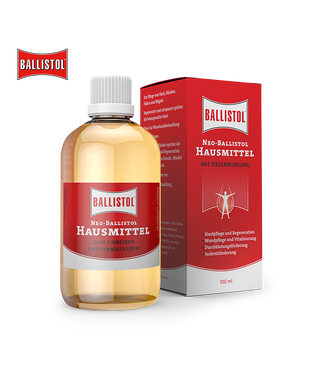
Ballistol Animal Care Oil comes in a 100 ml bottle that sits happily by the back door all winter. For advice on using it with your dog, call +44 (0) 7817 267314 or email sales@ballistol.co.uk.
More guides: How to Soften Leather · How to Open a Frozen Car Door · How to Use Cuticle Oil
Written by Ballistol UK. How we write and check our guides.
This guide is general advice. If you're unsure whether a product suits your item, contact Ballistol UK or a qualified professional first, and don't use it until your concerns have been answered.